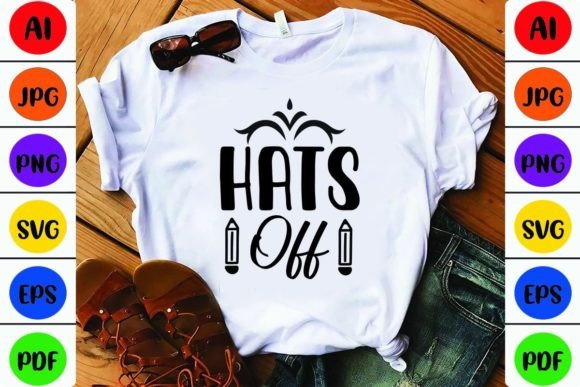
Hats Off: A Designer’s Review for Real Embroidery Projects
As an embroidery designer who has spent years digitizing files and testing them on everything from stiff canvas to flimsy rayon, I have learned that a pretty preview image is only half the battle. The real test happens when the needle hits the fabric. Recently, I downloaded Hats off, a teacher-themed SVG design cut file illustration, to see how it holds up in actual production. This isn’t just about whether the lines are clean on a screen; it is about whether this asset translates into a high-quality finished product that you can confidently sell or gift.
The description markets this as suitable for men, women, kids, babies, and girls, with applications ranging from scrap posters to t-shirts. While the versatility is appealing, my job is to look past the marketing copy and evaluate the structural integrity of the design for Crafts and Graphics applications. Here is my honest assessment of how Hats off performs in a real-world studio environment.
First Impressions and Visual Personality
When I first opened the file, the immediate impression was one of playful professionalism. The theme centers on education, which is a perennial best-seller in the craft business sector. The layout feels balanced, avoiding the cluttered look that plagues many instant-download designs. For an embroidery project, clarity is king. If the shapes are too complex or the lines too thin, they get lost in the thread.
Hats off possesses a visual personality that is friendly yet structured. It does not scream for attention with excessive detail, which is actually a strength. In embroidery, less is often more. The design’s simplicity suggests it was created with vector precision, which is crucial when converting a digital embroidery file into stitch data. The mood it creates is celebratory and appreciative, making it an ideal candidate for end-of-year teacher gifts, graduation acknowledgments, or back-to-school promotions.
Real-World Application: The Custom Tote Bag Test
To truly evaluate this design, I simulated a common client request: a personalized tote bag for a favorite elementary school teacher. I chose a medium-weight cotton canvas, a standard choice for tote bag design projects. The goal was to create a handmade product that felt durable and professional, not like a quick DIY experiment.
I placed Hats off centrally on the bag. Because the design is described as an illustration for various demographics, I needed to ensure it scaled well without losing definition. On the tote, the design sat comfortably within a 5x7 inch hoop area. The result was crisp. The lines translated well into stitch paths, assuming proper digitization. For an Etsy seller or small shop owner, this reliability is vital. You cannot afford to re-hoop a item because the design collapsed into a bird’s nest of thread.
This scenario highlights why Hats off works well for custom apparel and accessories. It is versatile enough to appeal to a broad audience—men, women, and children—without feeling overly gendered or age-specific. This universality increases its value as a design asset in your library, allowing you to use one file for multiple product lines.
Stitching Considerations and Fabric Compatibility
While the design looks promising, practical embroidery requires attention to technical details. Here is how Hats off interacts with different materials and stitching techniques.
- Fabric Texture: On smooth fabrics like polyester blends or high-thread-count cotton, the design shines. However, on textured fabrics like linen or heavy towel material, you must be cautious. Tiny details might get swallowed by the weave. I recommend using a cutaway stabilizer for these surfaces to prevent puckering.
- Stretchy Fabric: If you are applying this to a t-shirt or baby onesie, the stretch of the knit fabric can distort the image. Always use a hoop-within-a-hoop method or a strong tear-away stabilizer. For baby embroidery, comfort is key, so ensure the back of the stitches is covered with a soft backing if the design uses dense fills.
- Dark Fabric: When stitching on dark garments, contrast becomes an issue. If the design relies on fine lines, they may disappear. I suggest testing the design in a printable mockup with inverted colors first. You might need to add a white underlay or choose brighter thread colors to make the design pop against navy or black fabric.
- Curved Surfaces: The description mentions caps and hats. Stitching on a curved surface like a cap requires careful hooping. If Hats off has wide elements, ensure they do not exceed the curvature of the cap’s front panel. Distortion here can ruin the visual appeal.
Regarding stitch types, if you are digitizing this SVG yourself, consider using a satin stitch for borders and outlines to give a premium look. For larger filled areas, a fill stitch with appropriate density is necessary. Avoid excessive stitch density, as this can cause the fabric to pucker, especially on thinner materials like those used for greeting cards or lightweight shirts. A running stitch can be effective for delicate details, but it may not hold up well to frequent washing if not secured properly.
Commercial Viability and Brand Consistency
For small business merchandise and commercial embroidery, consistency is everything. Customers trust brands that deliver high-quality items every time. Hats off offers a clean aesthetic that aligns well with modern boutique branding. It does not look dated or clip-art-heavy, which helps maintain a professional image.
When selling personalized gift items, such as embroidered aprons or pillow covers, the perceived value is tied to the clarity of the design. A blurry or poorly stitched image lowers the perceived worth of the product. Because Hats off has a clear structure, it allows for consistent reproduction across different products. Whether you are making a sweatshirt embroidery piece for a staff uniform or a delicate embroidered patch for a backpack, the design retains its identity.
Furthermore, for holiday embroidery seasons like Teacher Appreciation Week or graduation, having a reliable, versatile file saves time. You do not need to redesign from scratch. You can quickly adapt the thread colors to match school colors or seasonal palettes, creating a cohesive collection for your small shop product lineup.
Practical Designer Notes for Best Results
Before you commit to a large batch of production, follow these steps to ensure success with Hats off:
- Test on Scrap Fabric: Never stitch directly on your final garment. Use a scrap piece of the same fabric and stabilizer combination to check for registration issues or puckering.
- Check Thread Contrast: Verify that your chosen thread colors stand out against the fabric. Use a color wheel tool if necessary to ensure accessibility and visual impact.
- Review Stitch Density: If you are digitizing the SVG, keep an eye on density. Too many stitches in a small area can break needles or damage delicate fabrics.
- Confirm Hoop Size: Ensure the design fits comfortably within your machine’s hoop size, leaving room for clamping and fabric movement.
- Inspect Small Details: Zoom in on the digital file. Are there any nodes or points that are too close together? These can cause thread breaks during stitching.
- Licensing Check: The product description mentions it is an instant download. Always confirm the license terms. Can you sell finished physical items? Can you use it for commercial clients? Clarify this before listing products on Etsy or other platforms.
In conclusion, Hats off is a solid addition to your library of Graphics and Crafts assets. It balances aesthetic appeal with practical usability. By understanding its strengths and limitations, you can leverage this design to create beautiful, profitable, and meaningful embroidered items. Whether for a custom apparel line or a one-off personalized gift, this design has the potential to perform well when handled with professional care.